Actual browser evidence / curated symbolic phrase
Plan the phrase.
Explain each position.
Piko separates an exact musical pitch from the places it can be played, then chooses an explainable route across a short monophonic phrase.
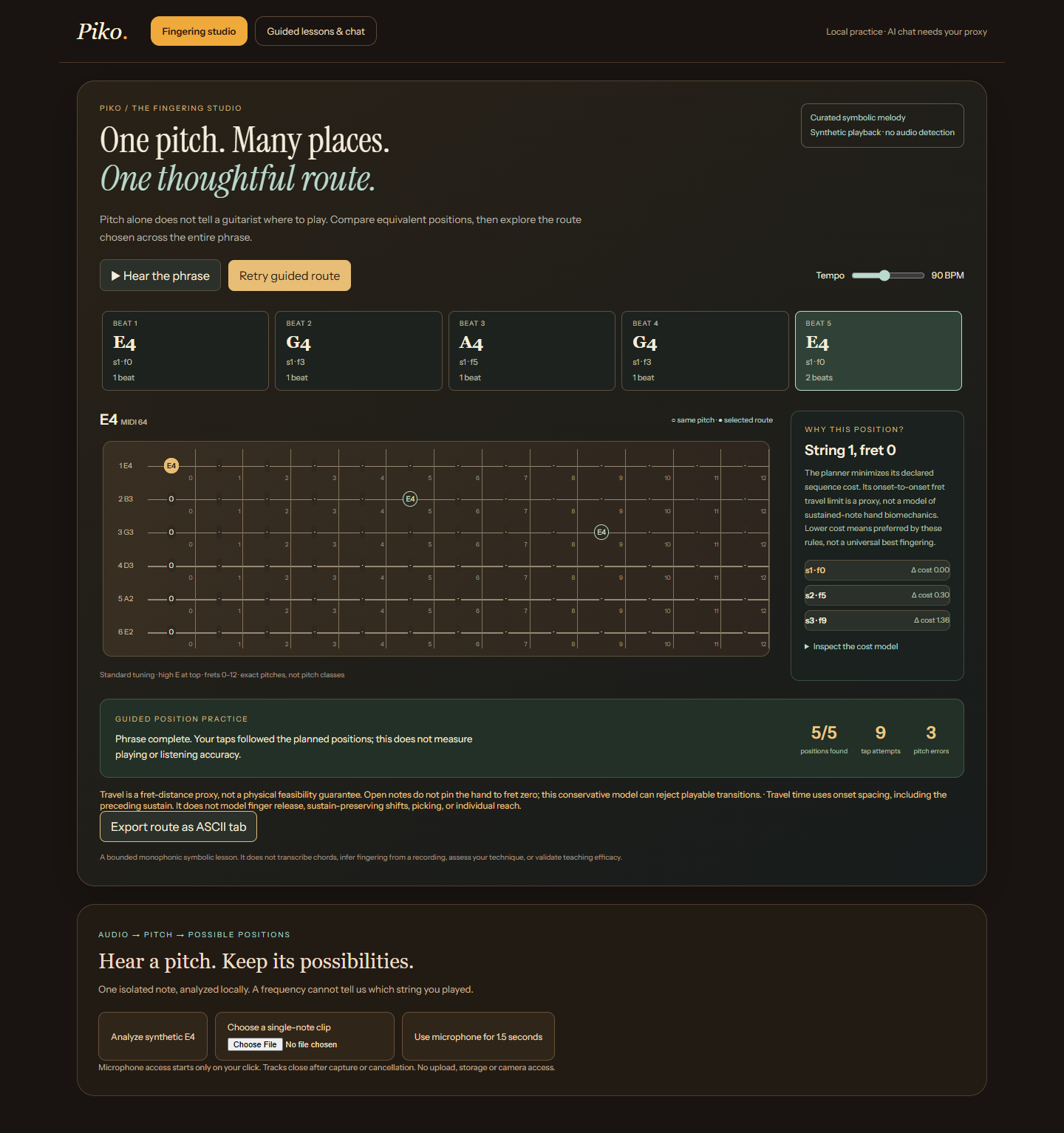
One pitch can have several positions
The planner enumerates positions for absolute MIDI pitches and evaluates the entire phrase with dynamic programming. An E4 target stays distinct from E3. Each alternate position includes the cost of the best complete route through it, or an explicit infeasibility result.
The cost combines declared preferences and a tempo-aware fret-travel bound. This is a limited onset/fret-distance proxy. It does not model held fingers, barres, individual reach or universal human comfort, and overlapping notes are refused.
Practice and export the selected route
The actual browser flow completed five planned taps, rejected a wrong-octave E3 attempt, accepted a different position with the same E4 pitch, and displayed hints after repeated errors. Playback could be stopped without advancing the selection.
The displayed studio uses standard tuning, capo 0 and frets 0–12. The underlying engine and export also preserve configured tuning, relative capo, tempo and onset/duration beats. The downloaded ASCII tab was checked for those fields. Its columns show event order, not proportional rhythm notation.
Keep audio observation separate
The local single-note lab analyzed an original synthetic E4 waveform and a local synthetic WAV; silence returned no guessed note. It reports candidate positions and a heuristic periodicity value. No physical microphone or recorded guitarist was used.
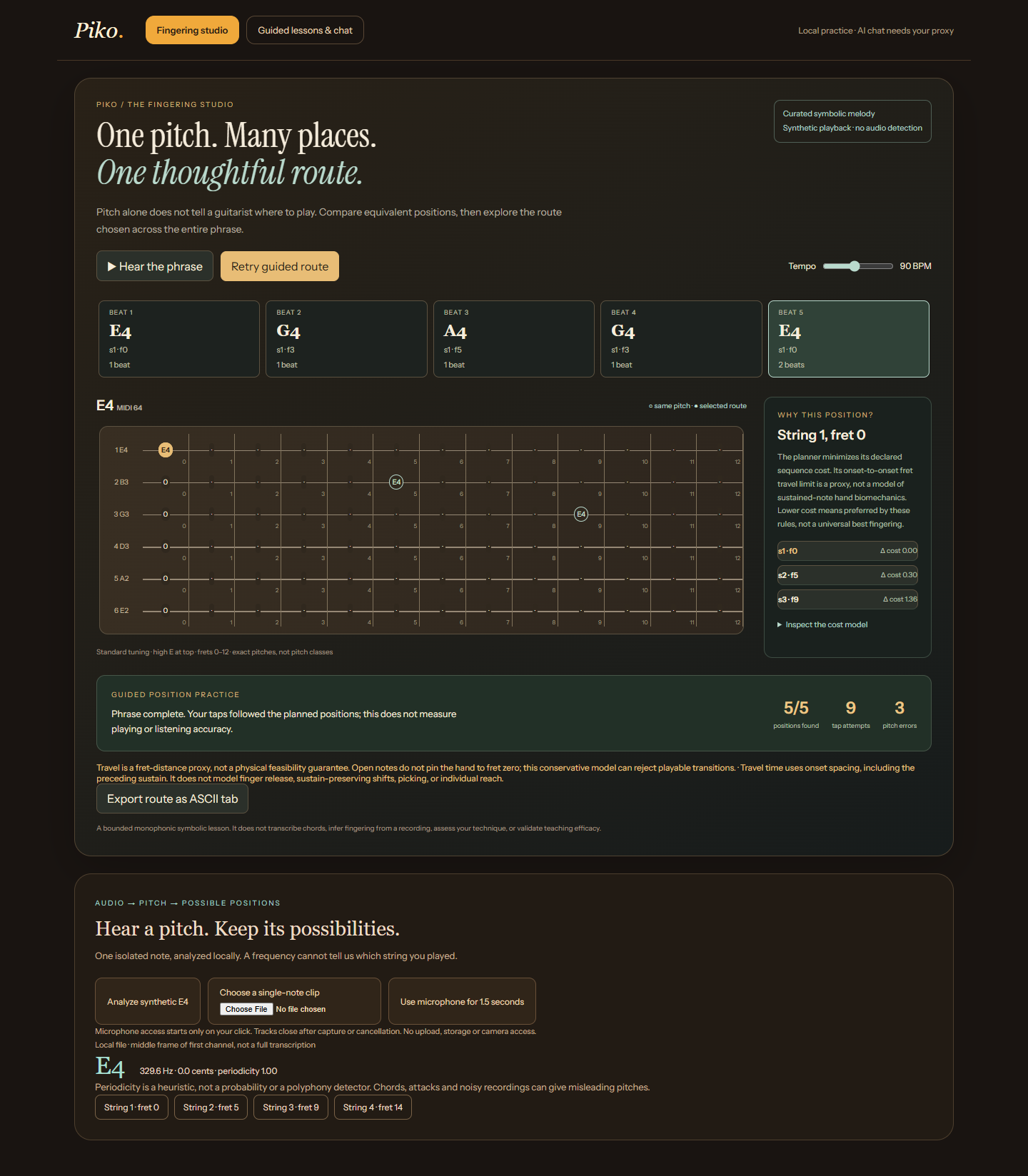
Verification and capture timing
On October 1, 2026, the merged source passed 111 tests in 12 files and its production build. Coverage includes planner optima and alternatives, exact-octave validation, export metadata, invalid input, and sample-rate-aware synthetic audio handlers.
These committed screenshots and the recorded browser journey come from the earlier studio verification. Later note-validation and audio-window corrections passed the 111-test suite; the browser flow and screenshots were not rerun for those corrections.
Real-guitar transcription accuracy, polyphonic transcription, original-string recovery, technique grading, teaching efficacy and production readiness are not established. The optional AI proxy was not exercised. Curated lessons remain available separately.